Cucumber (Cucumis sativus)
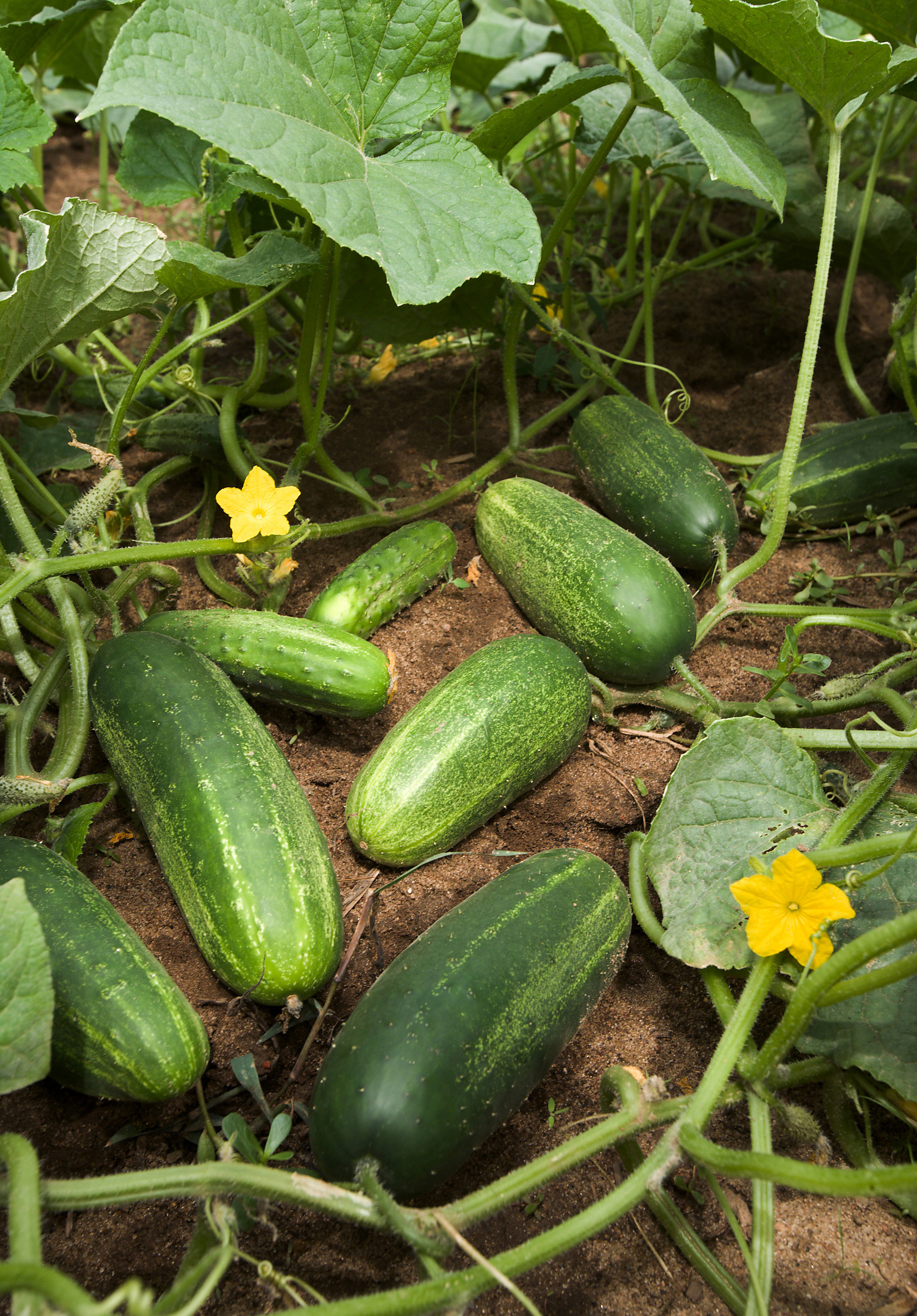
Cucumber is one of the fastest-growing greenhouse crops. Because of its extremely high leaf area index (LAI) and soft tissue, it is highly sensitive to humidity and transpiration stress. Precision steering is required to manage its massive water requirements while keeping vegetative and generative loads balanced, preventing diseases like powdery mildew and downy mildew. From a quantitative horticultural engineering standpoint, commercial Cucumber (Cucumis sativus) production in Venlo glasshouses and multi-tier plant factories is governed by the coupled heat and mass transfer equations of the Penman-Monteith canopy evapotranspiration model. Achieving target photosynthetic assimilation under a Daily Light Integral (DLI) regime of High (20-26 mol/m²/day) requires maintaining stomatal conductance (g_s) within its optimal physiological window while preventing aerodynamic boundary-layer stagnation (r_b) across dense leaf canopies. Because Cucumis sativus exhibits a high (rapid fruit expansion) physiological demand for xylem-mobile divalent calcium (Ca²⁺) alongside an electrical conductivity (EC) tolerance envelope of Moderate (1.8 - 2.8 dS/m), minor deviations in leaf-to-air Vapor Pressure Deficit (VPD) or root-zone dissolved oxygen (DO) rapidly manifest as localized meristematic necrosis, blossom-end rot, or vascular tip-burn. Furthermore, integrated pest and pathogen exclusion protocols must continuously suppress Pseudoperonospora cubensis (Downy Mildew), Pythium aphanidermatum by eliminating nocturnal dew-point condensation events through synchronized under-gutter hydronic pipe heating, variable-frequency horizontal airflow (HAF) fans, and automated dehumidification heat recovery.
Global Climate & Facility Engineering Strategy
🌍 South Korea (RDA Smart Farm)
Typically grown in plastic multi-span greenhouses. Requires strong night heating (15-18°C) to prevent downy mildew during winter. Focus is on air circulation to reduce boundary layer humidity around the dense canopy. [1] Facility SCADA controllers continuously cross-reference aspirated PT1000 dry-bulb/wet-bulb psychrometers with infrared radiometric leaf-surface temperature sensors to calculate real-time leaf-to-air VPD rather than relying solely on ambient air relative humidity. Automated proportional-integral-derivative (PID) loops modulate roof vent apertures, energy-saving aluminized screens, and variable-speed circulation fans to keep canopy boundary-layer resistance below 60 s m⁻¹ and prevent microclimatic stratification across Cucumis sativus production zones.
⚙️ Tech Level: Medium (Forced-air heaters, air circulation fans, drip irrigation)🌍 The Netherlands (WUR)
High-tech cultivation on rockwool gutters with high plant densities. High-wire training systems are standard. Focus is on managing VPD precisely (0.7 - 1.1 kPa) to ensure constant transpiration without causing root-zone waterlogging. Facility SCADA controllers continuously cross-reference aspirated PT1000 dry-bulb/wet-bulb psychrometers with infrared radiometric leaf-surface temperature sensors to calculate real-time leaf-to-air VPD rather than relying solely on ambient air relative humidity. Automated proportional-integral-derivative (PID) loops modulate roof vent apertures, energy-saving aluminized screens, and variable-speed circulation fans to keep canopy boundary-layer resistance below 60 s m⁻¹ and prevent microclimatic stratification across Cucumis sativus production zones.
⚙️ Tech Level: Very High (Rockwool slab gutters, high-wire training, high-pressure fogging)Crop Steering Parameters
Cucumber steering must be highly reactive due to the rapid growth cycle. The goal is to maintain strong vegetative vigor (thick stems) while steering generatively to support fruit elongation. Precision steering in Cucumber (Cucumis sativus) requires coordinating diurnal temperature differentials (DIF), canopy-level Vapor Pressure Deficit (VPD), spectral photon ratios, and substrate dry-back percentages (Δθv) so that assimilate partitioning between structural vegetative sinks and generative or secondary metabolic sinks remains in thermodynamic equilibrium.
Stoichiometric Fertigation & Rhizosphere Strategy
Cucumbers require a massive amount of water and a balanced nutrient supply. High potassium levels are required to support fruit expansion and maintain fruit quality. Electrochemical balance in the rhizosphere requires strict maintenance of electroneutrality between macronutrient cations (K⁺, Ca²⁺, Mg²⁺, NH₄⁺) and anions (NO₃⁻, H₂PO₄⁻, SO₄²⁻), preventing competitive transporter antagonism and stabilizing root-zone pH within the optimal 5.6–6.2 bioavailability window.
Phase 1: Vegetative Vigor & Anabolic Assimilation
Balanced Nitrogen and Phosphorus to support rapid root and shoot expansion. Target EC: 1.8 - 2.0 mS/cm. Monitor return drainage volume (20–30% leach fraction in substrate culture) and inline dissolved oxygen saturation (> 8.2 mg L⁻¹ at 20.0°C) to sustain root mitochondrial ATP synthesis and plasma membrane H⁺-ATPase proton-pumping kinetics. Chelated micronutrients (Fe-EDDHA/DTPA 35–55 µM, Mn 10 µM, Zn 5 µM, B 35 µM, Cu 1.0 µM, Mo 0.8 µM) must be dosed proportionally to prevent latent enzymatic cofactor deficiencies.
Phase 2: Generative / Phytochemical & Osmotic Steering
Increase Potassium (K) relative to Nitrogen (N) for fruit cell elongation. Target EC: 2.2 - 2.6 mS/cm. Monitor return drainage volume (20–30% leach fraction in substrate culture) and inline dissolved oxygen saturation (> 8.2 mg L⁻¹ at 20.0°C) to sustain root mitochondrial ATP synthesis and plasma membrane H⁺-ATPase proton-pumping kinetics. Chelated micronutrients (Fe-EDDHA/DTPA 35–55 µM, Mn 10 µM, Zn 5 µM, B 35 µM, Cu 1.0 µM, Mo 0.8 µM) must be dosed proportionally to prevent latent enzymatic cofactor deficiencies.
Cross-Crop Benchmarks & Companion Risk Matrix
📊 Comparative Physiological Demands
- DLI Requirement Level: High (20-26 mol/m²/day)
- EC Tolerance Range: Moderate (1.8 - 2.8 dS/m)
- Calcium Demand / Risk: High (Rapid Fruit Expansion)
🛡️ Shared Pathogens & Spatial Companions
- Shared Pathogen Risk: Pseudoperonospora cubensis (Downy Mildew), Pythium aphanidermatum
- Companion CEA Crops: Lettuce
- Encyclopedia Sync Date: 2026-08-05
⚙️ Thermodynamic, Mass-Transfer & Bioenergetic Engineering Analysis: Cucumber (Cucumis sativus)
In high-precision Controlled Environment Agriculture (CEA), optimizing Cucumber (Cucumis sativus) (Cucumis sativus) requires solving the coupled energy and mass balance across the soil-plant-atmosphere continuum (SPAC). At the canopy boundary layer, net radiative energy absorption (R_n)—comprising solar shortwave transmission and supplemental solid-state LED photon flux—is partitioned between sensible heat convection (H) and latent heat of transpiration (λE) according to the Penman-Monteith equation. When aerodynamic boundary-layer resistance (r_b = δ / D_v, where δ is the laminar sub-layer thickness and D_v is molecular diffusivity) is excessive due to stagnant horizontal airflow (< 0.15 m s⁻¹), leaf surface temperature (T_leaf) rises 1.5°C to 3.2°C above ambient dry-bulb air temperature (T_air). This thermal decoupling exponentially inflates the leaf-to-air Vapor Pressure Deficit (VPD_leaf = e_sat(T_leaf) − e_air), triggering abscisic acid (ABA) and hydraulic guard-cell closure (increasing stomatal resistance r_s > 450 s m⁻¹). Once stomata constrict, intercellular CO₂ concentration (C_i) plummets while transpirational xylem mass flow of non-phloem-mobile calcium (Ca²⁺) and boron (B) to rapidly dividing meristems stalls.
Simultaneously, within the rhizosphere and cellular metabolic network (Cucurbitaceae (박과) — Cucumis (오이속)), nutrient ion uptake is governed by active electrochemical proton gradients generated by root plasma membrane H⁺-ATPase (EC 7.1.2.1). Each mole of nitrate (NO₃⁻) symported across the root epidermis requires co-transport of two protons (2H⁺) and sustained mitochondrial oxidative phosphorylation (ATP synthesis), which in turn obeys Michaelis-Menten kinetics with respect to dissolved oxygen concentration (K_m ≈ 0.8–1.2 mg O₂ L⁻¹, with functional saturation requiring DO > 8.0 mg L⁻¹ at 20°C). By integrating canopy psychrometric enthalpy balances with root-zone Nernst-Planck ion diffusion and metabolic flux control, CEA systems engineers prevent both aerial photoinhibition and rhizosphere hypoxia, achieving deterministic yield stability and premium phytochemical density.
📡 Industrial Sensor Telemetry, PLC Control Architecture & Actuator Safeguards
Commercial deployment of the Cucumber (Cucumis sativus) engineering protocol relies on a three-tier distributed supervisory control and data acquisition (SCADA) architecture. Field-level sensing must avoid unshielded wall-mounted temperature/humidity probes; instead, deploy aspirated PT1000 psychrometer boxes positioned at the active apical canopy plane alongside narrow-field-of-view (15°) Apogee or Heitronics infrared radiometers measuring true leaf surface temperature (T_leaf ± 0.2°C). Photosynthetically Active Radiation (PAR, 400–700 nm) and extended ePAR (400–750 nm including Far-Red) are integrated at 10-second intervals via cosine-corrected quantum sensors to compute real-time accumulated Daily Light Integral (DLI) and dynamically modulate LED PWM dimming or supplemental lighting hours.
In the fertigation loop, redundant dual-junction glass pH electrodes, 4-ring toroidal conductivity (EC) cells, and optical luminescence Dissolved Oxygen (DO) transmitters continuously audit both injection supply headers and return drainage troughs. Frequency-Domain Reflectometry (FDR) dielectric slab sensors monitor volumetric water content (θ_v, % VWC), pore-water electrical conductivity (EC_p), and root-zone temperature (RZT). Programmable Logic Controllers (PLCs) enforce hard hardware interlocks: if supply EC deviates by more than ±0.25 dS m⁻¹ from setpoint, or if supply pH drops below 5.2, Venturi dosing valves automatically latch into bypass recirculation mode and trigger a high-priority operator alert.
❓ Frequently Asked CEA Engineering Questions (FAQ)
Q: How does leaf temperature (T_leaf) vs. air temperature (T_air) affect VPD calculation in Cucumber (Cucumis sativus)?
Standard ambient VPD calculations assume T_leaf equals T_air, which introduces a 15–35% error in Cucumber (Cucumis sativus) canopies. Under high solar radiation or HPS lighting, T_leaf exceeds T_air by +1.5°C to +3.0°C, raising internal leaf saturation vapor pressure (e_sat) and driving true leaf-to-air VPD much higher than wall sensors indicate. Conversely, under high-efficiency LED lighting without thermal IR radiation, high transpiration cools T_leaf 0.8°C to 1.5°C below T_air. Always compute VPD using an infrared leaf radiometer to prevent hidden stomatal closure or nocturnal condensation.
Q: What is the optimal root-zone dissolved oxygen (DO) and temperature threshold to prevent root hypoxia in Cucumis sativus?
In hydroponic and substrate systems for Cucumis sativus, nutrient solution temperature should be stabilized between 18.0°C and 21.0°C with dissolved oxygen maintained at 8.2 to 10.5 mg L⁻¹ (> 95% saturation, or supersaturated via Venturi/nanobubble injection). Above 23.0°C, Henry's Law oxygen solubility drops while root mitochondrial respiration doubles per 10°C (Q₁₀ ≈ 2.1), rapidly depleting boundary-layer O₂ below 4.0 mg L⁻¹, halting active Ca²⁺/NO₃⁻ uptake, and inviting opportunistic Pythium and Phytophthora zoospore infection.
Q: How should EC and irrigation dry-back (ΔVWC) be adjusted when transitioning Cucumber (Cucumis sativus) from vegetative to generative steering?
To steer Cucumber (Cucumis sativus) vegetatively, initiate irrigation 30–45 minutes after sunrise using small shot volumes (2–3% of substrate volume) at high frequency to hold volumetric water content (VWC) stable with minimal overnight dry-back (6–8%) and moderate EC. To steer generatively or induce phytochemical accumulation, delay the first morning irrigation until 90–120 minutes after sunrise, increase individual shot volume (4–6% VWC) at lower frequency, enforce a controlled overnight dry-back of 12–16% VWC, and elevate root-zone EC by +0.5 to +1.2 dS m⁻¹ while increasing potassium and sulfate ratios.
Ready to Steer Your Facility with Precision?
AgriAtlas provides the biophysical and thermodynamic governing theory, while our interactive engineering simulators compute exact psychrometric Vapor Pressure Deficit (VPD), leaf boundary-layer transpiration, and structural U-value heating loads for your specific greenhouse or vertical farm geometry.